
(2026) Bd. 1, 25–45
Thank you very much for coming to celebrate the end of my career at the University of Bern with me. I will begin with a personal prayer – which, in contrast to the title, I address to God without quotation marks.
Eternal One, Eternal you: I thank you that you are not a self-absorbed, unmoved mover – as the great philosopher Aristotle would have us believe. Rather, you are a person who loves us humans lavishly. Therefore, we may call you Dad and Mum.
Eternal Word: Thank you for not remaining in heavenly spheres, but for giving yourself to us in the greatest act of love imaginable. This is why you are the way, the truth and the life for me.
Eternal Spirit: Thank you for being radical love and for always being ready to accompany every one of us. Come, Holy Spirit!
My prayer expressed a way of addressing God. I deliberately put the word »God« in quotation marks in the title, because there are many ways to address and experience transcendence. The quotation marks emphasize this diversity of content and bracket a theological definition of this transcendence. At the same time, I also bracket ontological questions.1
The following discussion will therefore not focus on a Christian and Trinitarian God, but rather on encounters with transcendence. »God« (in quotation marks) thus stands for transcendence. In this sense, the main title is more accurately phrased as »Transcendence still encounters us«. And I would add from an anthropological perspective, it will always encounter us.
My farewell lecture is based on two theses about the future of empirical religious studies – particularly speaking of sociology and psychology of religion – and of theology and the churches.
First thesis: If we want to gain an accurate picture of the current state and possibilities of development of religion and spirituality in our society, experiences of transcendence and their interpretations must be examined, reflected upon and discussed more intensively.
Second thesis: If theology and the church want to play a role in communicating religion and spirituality, they should take into much greater account the experiences of transcendence of people living today and their individual interpretations. They must become much more empathetic towards experiences of transcendence. This would make them more relevant to people.
Let us begin with a definition of religion by Thomas Luckmann:
»My view of religion is that it is based on the socializing of dealing with experiences of transcendence, that this is its ›function‹. By ›religion‹ I therefore mean that core element of the social construction of reality which shapes and bindingly regulates the way we deal with transcendence, especially the ›great‹ transcendence, with varying degrees of success«.2
I would like to discuss two terms in this definition: experiences of transcendence and religion.
Luckmann, following his teacher Alfred Schütz, distinguishes between three types of experiences of transcendence – little, intermediate and great. All three forms involve transcending or going beyond the here and now of everyday life. The differences lie primarily in the scope of this transcendence.3
Luckmann speaks of little transcendences »when the unexperienced, as indicated in the present experience, is fundamentally just as experiential as the currently experiential«4. This is the case, for example, when you think about your future and run through various possibilities – e.g. the desire to become a car mechanic. In this example, you do not (yet) experience working as a car mechanic in your present experience. It is only present as a possibility – as something not yet experienced in the present. But as soon as you start working as a car mechanic, this possibility becomes reality and thus experiential. Why is the future experience as a car mechanic just as experiential as the present experience? Quite simply: because it is you yourself who will have this experience in the future. The frame of reference remains the same.
At the same time, something new enters your life that you did not know before. In the example, you learn what it feels like to work as a car mechanic. Such small experiences of transcendence occur constantly in our lives. We are constantly having new experiences; we transcend or go beyond our current horizons and become partly new in the process. Therefore, transcendence is inscribed in our very essence. We are transcendent beings. In a sense, we are constantly being reborn in this way. With this allusion to the New Testament metaphor of rebirth, I would like to suggest that little transcendences are by no means trivial. They can lead to enormous and profound changes. Last but not least, little transcendences are linked to a big question that preoccupies us all: Who am I? As a mnemonic, I suggest: I’m not finished and locked in. By that I mean: we are not closed off, but open. Each of us can become new.
Luckmann speaks of intermediate transcendence »when the present is experienced only indirectly and never directly, yet still as part of the same everyday reality«5. Little transcendence can always be experienced directly because it is I myself who experiences it. The frame of reference remains the same. This is true even when I undergo profound changes. In contrast, in intermediate transcendence, the present can only be experienced indirectly. What does Luckmann mean by this? Well, I experience something indirectly when another person tells me something about their life – for example, that they have experienced a turning point in which many things, perhaps even everything, has changed for them.
Regarding intermediate transcendence, I transcend my frame of reference towards the direction of another person's frame of reference. I try to empathize with another person and understand them. This empathy has enormous consequences for how we interact with each other: the better I can understand how another person sees the world, the more likely I am to play a role in their life. Without this, it would be impossible to raise children – or to have a successful romantic relationship. At the same time, this transcendence always remains precarious, because there is a boundary that I can never cross. I can never slip into another person's skin and actually see the world through their eyes. That is why we always need to talk – to listen to others and try to understand them.
The intermediate transcendence also has enormous consequences for my understanding of the world and myself. I realize that the world is not one-dimensional – just as I see it – but multidimensional. The world is also as others understand it. A second big question is connected to intermediate transcendences, one that we ask ourselves again and again (or at least should ask ourselves): Who are the others? And from this follows: Who are we? As a mnemonic, I suggest: The others are also not finished and locked in. I should remain in conversation with them. Therefore, we can become new together.
Through intermediate transcendences, I become aware that there are other frames of reference. At least I come into contact with these frames of reference in the same living environment: a shared world that can be described by the laws of physics and other natural sciences. This then appears to be safe and stable ground. But this ground is not so stable, as it is called into question by great transcendences.
Luckmann speaks of great transcendence »when something is perceived only as a reference to another, extraordinary reality that cannot be experienced as such«6. That's pretty intense. It's about experiences of an other, extraordinary reality. In other words, it is about something that I do not normally encounter. That is extreme. But it gets even more extreme, because it is about experiences of a reality that is actually not experienceable as such. I interpret this to mean that Luckmann is alluding to a reality outside of space and time. For space and time structure our apparatus of perception and thought – and thus our space of perception. Outside of space and time, we cannot actually experience anything. In other words, the experience of great transcendence is an indication of »something« beyond. Let's take a look at a few examples to make this more concrete. I'll start with two examples that Luckmann himself mentions:
First, there is the dream: in dreams, we often move in a surreal world. In it, the laws of time and space are suspended. We can fly, for example – and much more. One might counter but that's just a dream. True, it is only a dream. Nevertheless, dreams reveal a reality that, as such, cannot actually be experienced.
It is no coincidence that the Bible occasionally describes a heavenly reality in the form of a dream – think, for example, of Jacob's dream of the ladder to heaven (Genesis 28:11–17).
Let us move on to the next example. Luckmann also refers to the phenomenon of ecstasy, i.e. losing control of oneself. Here he refers to drugs, intoxication and sexuality. Like dreams, ecstasy also occurs in the Bible. For example, in one of his letters, the Apostle Paul recounts that he was in the third heaven (2 Corinthians 12:2–4).
To take this a step further, let us think beyond Luckmann’s examples:
What about so-called paranormal experiences? Examples include telepathy, precognition, ghostly apparitions, messages from the dead, and near-death experiences. Almost all of us have had such paranormal experiences at some point.
And last but not least, there are the stories from the Bible and other sacred writings that describe situations in which »God« is encountered. Consider, for example, the story of the burning bush, which does not burn up, and from which a voice speaks, introducing itself as »God« (Exodus 3:1–4:17). This, too, is an extraordinary reality that cannot actually be experienced as such.
The great transcendences are ultimately linked to the biggest questions we can ask ourselves: What is the meaning of it all? And with regard to a possible source of meaning: Does God exist? After all, we can conceive God – this is neither self-evident nor trivial, but rather a constant challenge. And when I consider that God exists, the biggest question inevitably arises: Who is God?
As a mnemonic for the great transcendences, I suggest: The world as a whole is also not finished and locked in. It can become new as a whole. In this context, I read the philosophy of Ernst Bloch, which can be interpreted as »dialectical agnosticism«7 and in which an ontology8 is developed whose living core is the »not yet«. In this context, I also read the following sentence, which appears near the end of the last book of the Bible: »Behold, I make all things new!« (Revelation 21:5a).
I have now spent a long time dwelling on the concept of experience of transcendence. This was necessary because my lecture and my theses deal essentially with experience of transcendence. We have to be clear about what we were talking about. I will thus briefly discuss the term religion.
Religion is not identical with the church – nor with other religious institutions. Unfortunately, this theoretically and empirically unfruitful identification is all too common. In contrast, Luckmann's definition broadens our view of religion. Religion is the social construction of dealing with experiences of transcendence. Of course, churches and other religious institutions play an important role in this. But there are other social institutions that participate in this social construction. Think of works of art of all kinds (visual arts, music, literature); think of modern culture with its films (images that leave a lasting impression!) and the boundless communication on social networks. There, communication about experiences of transcendence takes place on a massive scale.
The less churches talk about experience of transcendence in their practice, the more they lose relevance in the social construction of dealing with experiences of transcendence.
This brings me to the two-source theory of religion announced in the invitation.9 With reference to Luckmann, it is actually a two-source theory of the social construction of dealing with experience of transcendence. I have prepared the following figure for this:
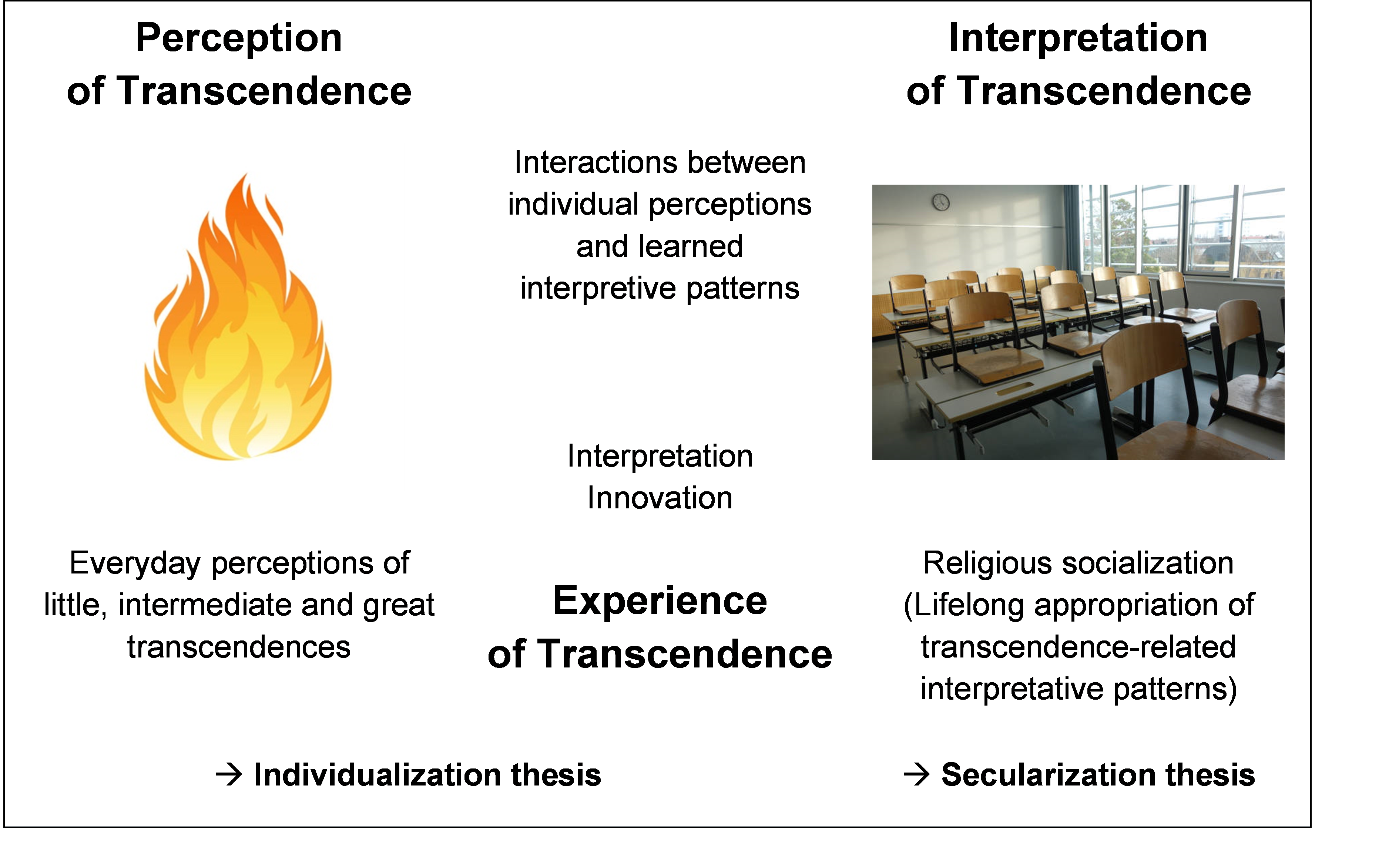
The illustration shows the two main sources of religion that I have postulated. On the left-hand side are perceptions of transcendence. These are perceptions of transcending the here and now of the present everyday world. As discussed above, this occurs constantly in our everyday lives – in the form of small, medium and large perceptions of transcendence. We perceive that there is »something« else. This gives rise to the big questions again and again: Who am I? Who are we? Who is God?10 Such perceptions are part of human nature. They are experienced by individuals time and again. Without these perceptions, which arise again and again, there would be no need for religion. I would even venture to say that, from an anthropological perspective, they are the beginning of religion. Therefore, the left side marks the primary source of religion. And I would like to add: this source is the foundation of the relative autonomy of religion and religious thought, and thus of theology.11
On the right-hand side are interpretations of transcendence. They are based on traditions consisting of stories about and interpretations of perceptions of transcendence, as well as techniques and practices for evoking and actualizing them. These can be found in religious traditions, but also in art and culture, and are conveyed through processes of religious socialization – and I would like to emphasize here: lifelong. Religious socialization never stops, because perceptions of transcendence never stop. Traditional knowledge facilitates the identification, interpretation and handling of perceptions of transcendence. And, last but not least, they can also lead to an increase and deepening of perceptions of transcendence. In the process, quiet and mild perceptions that there is »something« else can become powerful and stormy experiences that lead to radical changes in the self, society and the world.
In the previous sentence, I distinguished between perceptions and experiences of transcendence. I speak of a perception of transcendence when someone becomes aware that there is »something« beyond the here and now of everyday life. This »something« remains undefined – and, as something undefined, can easily disappear into oblivion again. However, if the »something« is defined, then the perception becomes an experience. Experiences of transcendence thus arise only from the interaction between perceptions of transcendence and knowledge about possible interpretations or patterns of transcendence. An experience of transcendence is always linked to an interpretation of a perception of transcendence. For this reason, the experience of transcendence is located between perception and knowledge in the illustration. Last but not least, the interaction between perception and knowledge also gives rise to religious innovations and new patterns of interpreting transcendence.
The individualization and secularization theses are shown at the bottom of the illustration. In my view, the strength of both theories lies in the respective source of religion to which they refer in their empirical research. This strength becomes a weakness when they fixate on one of the two sources. Then they are unable to adequately grasp the phenomenon of religion. Therefore, I combine the proposed two-source theory with a call to reconcile both strands of research.
In the two-source theory of religion, I assume that experiences of transcendence are anthropologically conditioned. As human beings, we cannot escape these experiences simply because of the way we perceive, feel and think. Of course, religious socialization equips us with patterns of interpretation that make it easier for us to interpret experiences of transcendence. Those who have learned a lot about experiences of transcendence in their lives can identify and interpret them more easily and deal with them more confidently. However, due to their anthropological basis, they also enter our consciousness when religious socialization is only weakly developed. This assumption opens up the possibility of an empirical test of the two-source theory.
Secularization theory postulates that with increasing modernization, all dimensions of religiosity decline.12 Over decades, this has been demonstrated very impressively in numerous representative studies with regard to the dimensions of church membership, church attendance and prayer.
Now, attending church services and praying are practices that are learned during religious socialization. Even as small children, we learn how to pray and how to behave in church services within our families. Or – we simply do not learn it if these practices do not occur in our families. Religious sociology refers to this as a break with tradition. If religious socialization is the most important source of religious behavior, then a break with tradition must inevitably lead to a massive decline in religion.
Now, in the two-source theory, I postulate that, in addition to socialization – and independently of it – experiences of transcendence repeatedly push their way into consciousness. From this, I derive the hypothesis that experiences of transcendence are not as strongly affected by declining religious socialization as learned religious practices. This can be empirically verified if large representative studies inquire not only about the frequency of prayer and church attendance, but also about the frequency of experiences of transcendence. Unfortunately, experiences of transcendence have almost never been taken into account in the major international sociological studies of religion that regularly conduct representative surveys. These include the European and World Value Survey (EVS13 / WVS14), the International Social Survey Programme (ISSP15) and the European Social Survey (ESS16). This gap is illustrated in Table 1.
Core-Dimension of Religiosity | EVS/WVS since 1981 | ISSP since 1991 | ESS since 2002 | RM since 2007 |
|---|---|---|---|---|
Consequences | always | always | always | always |
Belief in God | always | always | always | always |
Church attendance | always | always | always | always |
Prayer | always | always | always | always |
Experience of | only 1x (1981) | never | never | always |
Thinking upon | never | never | never | always |
As you can see, in the three largest international surveys on religion conducted over the past 40 years, questions about experience of transcendence were almost never included. The only exception was the first wave of the EVS in 1981, which included four questions on paranormal perceptions.17 Unfortunately, these questions were never asked again in subsequent studies. This situation only changed with the Bertelsmann Foundation's International Religion Monitor (RM18), which has been conducted in over 20 countries in four waves since 2007.
Perhaps this innovation is related to the fact that the initial concept for the RM was not developed by a sociologist of religion. At the very least, this reduced the risk of operational blindness. In 2006, the Bertelsmann Foundation commissioned four expert reports on the structure of the future RM. Not only sociologists of religion (Detlef Pollack, Heiner Meulemann) were consulted, but also psychologists of religion (Michael Utsch, Stefan Huber). This was highly innovative, because until then, only sociology had been responsible for representative studies on religion. I was present when the four expert reports were discussed in Berlin in January 2007 by a panel of very prominent figures. After about 10 minutes, Hans Joas – a sociologist of religion who takes a critical stance on secularization theory – spoke up with a very passionate plea to accept Stefan Huber's proposal. In my opinion, that settled the matter. I was given the task of designing the questionnaire for the first Religion Monitor. For the first time in a long while, questions about experiences of transcendence and the intellectual dimension of religiosity were included in an international study.19
In the RM, experiences of transcendence were operationalized by means of two questions:
How often do you experience situations in which you feel that God or something divine is intervening in your life?
How often do you experience situations in which you feel that you are at one with everything?
In the first question, transcendence is perceived as an entity that intervenes in one's own life. This implies an interactive pattern regarding transcendence. In the second question, transcendence is perceived as something in which I participate. This implies a participatory pattern.20
The RM makes it possible to empirically test my hypothesis that experiences of transcendence are not as strongly affected by declining religious socialization as learned religious practices. Table 2 shows a comparison of the mean values in five Western European countries from 2007 and 2017.
Dimension | Year | N | Mean | Change |
|---|---|---|---|---|
Church attendance | 2007 | 4965 | 2.49 |
|
2017 | 5499 | 2.37 | ||
Prayer | 2007 | 4942 | 2.63 | −0.18*** |
2017 | 5427 | 2.44 | ||
Meditation | 2007 | 4911 | 2.05 | −0.07*** |
2017 | 5464 | 1.98 | ||
Interactive Experiences | 2007 | 4913 | 2.25 | +0.17*** |
2017 | 5425 | 2.42 | ||
Participative Experiences | 2007 | 4756 | 2.34 | +0.10*** |
2017 | 5228 | 2.44 |
As expected, the frequency of church attendance, prayer and meditation are all declining – see the negative values in the right-hand column. Prayer has declined the most. All three differences are highly significant. In contrast, both forms of experiences of transcendence are increasing – see the two positive values in the right-hand column. Here, too, all differences are highly significant. The opposite development of learned religious practices and experiences of transcendence confirms my hypothesis. I take this finding as a strong indication that experiences of transcendence are not – or only slightly – affected by processes of declining religious socialization. This indirectly supports the assumption that they are essentially based on an anthropological constant.21
However, two aspects of this result raise questions:
Why is there not only consistency, but even an increase in experiences of transcendence? One possible explanation is that in a postmodern social climate, fundamental opposition to religion has softened. This makes it easier to acknowledge experiences that in the spirit of modernity could still be stigmatized as »religious«.
It is interesting to note that interactive experiences of transcendence are increasing more strongly than participatory ones – and this in the context of a greater decline in prayer than in meditation. This finding contradicts the assumption that holistic forms of religiosity benefit most from a postmodern religious landscape. The opposite seems to be the case. This should be investigated in more depth in further studies.
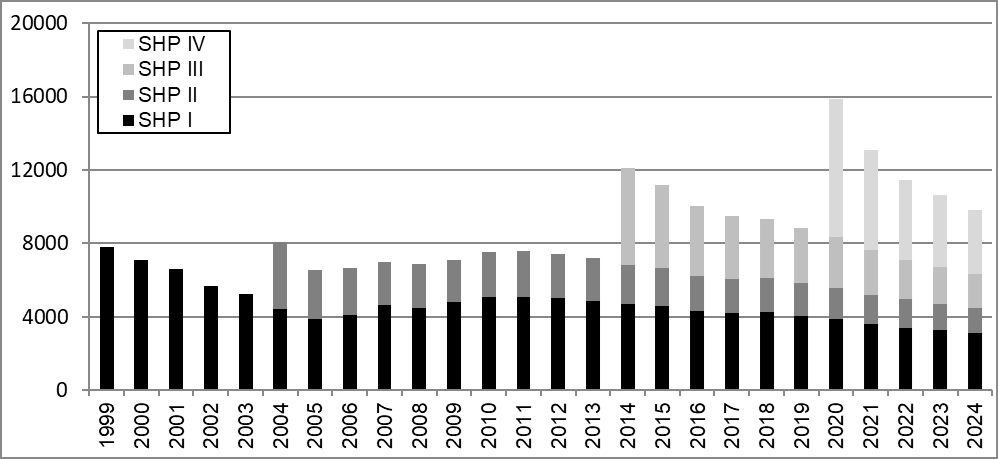
Let us now turn our attention to Switzerland, and in particular to Reformed Christians in Switzerland. The data from the Swiss Household Panel (SHP) provides us with an excellent basis for this. The enormous research potential of this panel, which has been running since 1999, can be illustrated by Figure 2 below.
It documents the number of respondents for each year – e.g. almost 8,000 in 1999.
The black or grey shaded parts of each annual bar indicate from which SHP sample the respondents come from. The first sample (SHP I) – black part of the bar – begins in 1999. In 2024, around 3,000 people from this sample were still participating. Their life stories have been documented over a quarter of a century through annual surveys. Refresher samples are added in decreasing shades of grey, which have been surveyed annually since 2004, 2014 and 2020 (SHP II, III, IV).
As in all other household panels in major industrialized nations, religion and religiosity are usually only surveyed using 1–3 items (membership, church attendance, prayer) for cost reasons. This was also the case in the SHP from 1999 to 2009.
For empirical religious research, it is a uniquely lucky case that the scientific management of the SHP decided to ask significantly more questions about religiosity every three years from 2012 onwards. Based on a suggestion I made, this religion module (R) contains 16 indicators, including the 7 questions from the centrality scale, which are also included in the RM, as well as 2 additional items from the RM on religious and spiritual self-concept. This is a quantum leap that opens up entirely new possibilities for empirical religious research – especially for analyses of changes in the multidimensional structure of religiosity.
This representative panel data makes it possible to reconstruct the development of several thousand members of the Reformed Church over the course of their lives – and, of course, members of other churches and religions, as well as those without religious affiliation. For example: joining and leaving churches; changes in the multidimensional structure of individual religiosity (prayer, worship, faith, experience, intellect); dealing with critical life events (birth, marriage, illness, unemployment, death of relatives – first-class data is also available on all these events).
The SHP's religion module also asks about the frequency of interactive and participatory experiences of transcendence. This allows us to examine how the frequency of these two experiences is changing and which factors are relevant. Table 3 documents the frequency of interactive and participatory experience of transcendence in 2021.
PARTICIPATIVE: How often do you experience situations in which you feel »being at one with everything«? | |||||||
|---|---|---|---|---|---|---|---|
never | rarely | occasionally | often | very often | SUM | ||
INTERACTIVE: How often do you experience situations in which you feel that God or something divine is intervening in your life? | never | 8.7% | 6.9% | 7.7% | 2.9% | 0.7% | 26.9% |
rarely | 3.4% | 11.5% | 12.4% | 5.9% | 0.6% | 33.9% | |
occasionally | 1.4% | 5.1% | 12.3% | 5.7% | 1% | 25.6% | |
often | 0.4% | 1.2% | 3.4% | 4.8% | 0.8% | 10.6% | |
very often | 0.2% | 0.1% | 0.7% | 0.8% | 1.3% | 3% | |
SUM | 14.2% | 24.9% | 36.5% | 20.1% | 4.4% | 100% | |
As you can see in the right-hand column of Table 3, around 73% of Reformed Christians experience such perceptions at least »rarely«. For 14%, they occur »often« or »very often«. In these cases, they are likely to have a strong influence on religious and spiritual experience and behavior. The bottom row of Table 3 documents the frequency of perceptions of participatory transcendence experiences – i.e. the experience of »being at one with everything«. According to the table, such perceptions occur at least »rarely« in 85% of Reformed Christians. In around 25% of cases, they occur »often« or »very often«. In these cases, they are also likely to have a strong influence on religious and spiritual experience and behavior.
Finally, Table 3 shows the percentage of Reformed respondents for all possible combinations of answers to both questions. I don't want to go through all 25 possibilities now, but I would like to ask you to focus your attention on the grey-shaded combination of »never« and »never«. As you can see, this is only the case for 8.7% of Reformed Christians. Conversely, this means that at least 90% of Reformed Christians in Switzerland have at least »rare« experiences of transcendence. Hence the title of my lecture, »God« is still encountered – even by Reformed Christians in Switzerland. I can prove that this estimate – based on two questions – is fairly valid through narrative interviews we conducted with 95 Reformed Christians from this SHP sample. Analysis of this qualitative data shows that only seven Reformed Christians in the interviews reported no experience of transcendence whatsoever. That is only 7.4%. The estimate based on quantitative questionnaire data that over 90% of Reformed Christians in Switzerland have experiences of transcendence is validated by qualitative data.
As already mentioned, the SHP provides a globally unique database for religious research. No other panel in the world asks such differentiated questions about the multidimensional structure of religiosity. This opens up a variety of unique religion-related analyses. However, the crowning glory of this already unique quantitative database consists of in-depth qualitative interviews that we were able to conduct with a sub-sample of the participants in the SHP. In the 2021 survey wave, an additional question was included at the end of the religion module: »Has there ever been a turning point in your life that changed your attitude towards religiosity or spirituality significantly?« (Possible answers: 1) Yes, 2) No, 3) Don't know). Around 20% of participants answered yes to this question. They were then asked if they would be willing to take part in an in-depth conversation about this turning point. Around 50% agreed (N is approximately 1,400). From this group of people, we ultimately conducted 365 narrative interviews with an average length of 79 minutes.23 Of the 365 people interviewed, 95 belonged to a Reformed church in Switzerland in 2021 or earlier (i.e., they left before 2021). As already mentioned, only seven Reformed Christians did not report any experiences of transcendence. This implies that 88 Reformed individuals in this sample reported experiences of transcendence. Three examples can be found in an online appendix to this article.24 A thorough analysis of the contents of the experiences of all interviewed Reformed Christians shall be published in 2026 in a book edited by Stefan Huber, Isabelle Noth and Alexander Trettin on Elements, Types and Dynamics of Protestant-Reformed Faith and Life Worlds.25
Finally, I would like to briefly address the subtitle in the announcement of my farewell lecture: »The king is dead, long live the king!« This phrase was proclaimed when a king died in France and the new king was simultaneously enthroned. Now, I am not a king, and I hope to live for some time yet. So the phrase does not refer to me, but to the Institute for Empirical Research on Religion at the Faculty of Theology of the University of Bern. The faculty has decided to dissolve this institute at the end of the year, following my retirement. The professorship for empirical religious research will also be discontinued. Therefore, it is dead. Now I have been appointed to a research professorship for Empirical Religious Research at STH Basel, starting on 1 January 2026. At the same time, I have founded an independent Institute for Spirituality and Empirical Theology26. This is the new king, succeeding the Bern Institute for Empirical Religious Research. I invite you to visit the website, where you can find out about current and planned research projects. There are also offers for individuals, groups and church communities.
My farewell lecture began with a prayer in which I professed to be a believer. After that, I put »God« in brackets and continued as a radical scientist committed to agnosticism in ontological questions. I would like to emphasize that this is very important to me. As a scientist, I try to follow the ethos of incorruptibility and impartiality as radically as possible, as well as the principle of sobriety and simplicity in the explanation of data. Now, at the end of the lecture, I return to the mode of the believer, in which I try to be as radical as possible. In this mode, I give glory to my God through the testimony of an experience of transcendence that I had 23 years ago. I was 42 years old at the time and had my first experience of great transcendence – at least the first experience that I clearly remember.
It was 2002. I had just defended my dissertation in psychology of religion and was at the beginning of a three-year research project funded by the Volkswagen Foundation to develop new religious psychology measurement instruments. At the same time, I had been married to Claudia for eight years, and my sons Yannick and Simon were just seven and five years old. Claudia, Yannick and Simon accompanied me to the airport in late summer, where I was flying to Glasgow. An international religious psychology conference was to take place there, at which I wanted to present my research program with two colleagues in our own panel. As I waited to board, I was suddenly overcome by the idea that my plane would crash. I was surprised and confused, as I had flown many times before without any fear of flying. I tried to calm myself down. But the thought became increasingly powerful and was linked to the imperative to cancel the flight and the conference participation, as I had to be there for my family and my sons. Despite all my attempts to calm myself – including using psychological techniques I had learned while studying psychology – I slipped deeper and deeper into panic. In this situation, my last idea was to try prayer. It was a short prayer in which I placed my sons' lives in God's hands: »God, you are the father of my sons. If I have to die now, you will take care of my sons.« It worked. I calmed down again. This experience can be interpreted as an answer to prayer, which in itself is a experience of transcendence. But that was not the end of the story. It culminated in ecstasy. On the airplane, I was given a window seat at the very back. The seat next to me remained empty. Above the clouds, I initially had an intense perception of nature. The cloud cover was closed and blooming white, above it stretched a bright blue sky. I just looked out the window and intoxicated myself with this seemingly endless wide-open space. Then I suddenly heard an inner voice: »Stefan, I will lead you into this wide space of freedom.« I knew immediately that it was God speaking to me through this inner voice. This realization sent me into a state of ecstasy that lasted the entire flight. I stared out of the window, spellbound, almost the whole time. I can also remember a stewardess looking at me with concern at one point. Thank God she didn't take any action, so that I could float in my ecstasy the whole time.
Now, 23 years later, I am taking a new step »into this wide space of freedom«. I would like to illustrate this step using the image of figure skating. Competitions start with the compulsory routine. You have to perform all the required figures very precisely. The judges stand by with stern expressions and note every millimeter that deviates from the prescribed line. I have fulfilled this compulsory part over the past 14 years at the Faculty of Theology at the University of Bern. Now, after my retirement, I am moving on to the freestyle skating. In other words, I now want to jump, dance – and maybe even sing.
English translation of the farewell lecture given in German at the University of Bern on 4 December 2025. I would like to thank my doctoral student Brittany Ehemann for the English translation. The text has been edited. The editing was based on questions and suggestions from colleagues at the colloquium on the lecture, which took place the following day. I would like to thank, in alphabetical order, Michael Ebertz, Isabelle Noth, Uta Pohl-Patalong, Gergley Rosta, Stefan Schweyer, Jörg Stolz and Anna-Katharina Szagun. I would also like to thank Mathias Allemand, Sarah Demmrich, and Bernd Schnettler for their comments on the manuscript and its translation into English. In editing the text, I took care to preserve the spoken style of the lecture. In addition, the text has been supplemented with notes explaining biographical and scientific contexts. The German text of the lecture is available at http://ifset.ch, and the podcast at https://tobira.unibe.ch/!v/EXrZHxn9v3D.