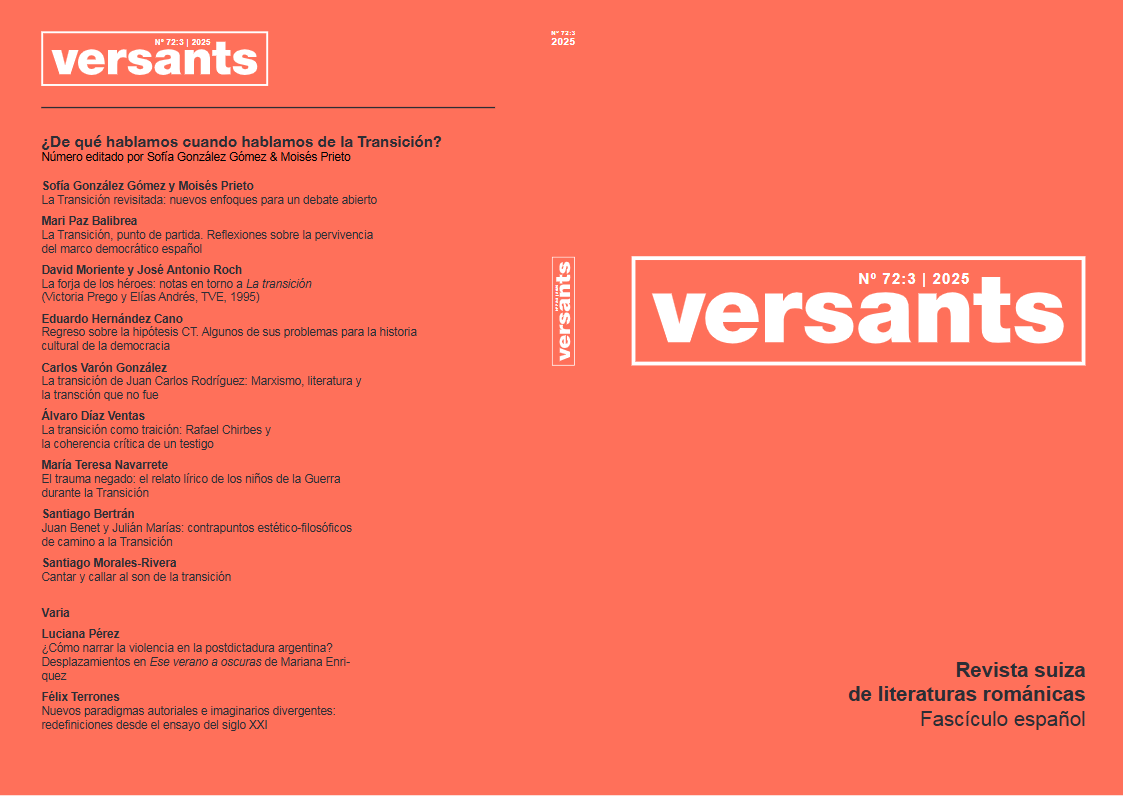
La transición de Juan Carlos Rodríguez: Marxismo, literatura y la transición que no fue
DOI:
https://doi.org/10.22015/V.RSLR/72.3.5Abstract
This essay explores the thought of Juan Carlos Rodríguez (JCR), a Spanish literary theorist whose work redefined the study of literature and subjectivity as the historical articulation of ideological contradictions. Beginning at a very specific historical and political context during the final years of the Franco dictatorship, Rodríguez insisted on approaching literature not as an autonomous entity, but as the objectification of ideological conflicts that exceed the individuality of the author. Through his reading of the Spanish Transition, he diagnosed a broader transformation of Spain’s cultural field from the 1970s through the 2008 crisis. For Rodríguez, the Transition was not just a historical episode or a chapter in a national narrative, but the culmination of a secular process of social transformation that continues to shape our present. The Spanish Transition was therefore less the end of Francoism than an unexpected moment in the evolution of capitalism, revealing the extent to which capitalist ideology permeates not only the economic realm, but also subjectivity, language, and literature itself. If, as Rodríguez argues, literature is a space to construct, explore, and question identity within a specific social formation, then the Transition remains central to any reflection on the role of literature today.
Downloads
Downloads
Published
Issue
Section
License
Copyright (c) 2025 Carlos Varón González

This work is licensed under a Creative Commons Attribution 4.0 International License.