The Journal of Black Opera and Music Theatre is the official journal of the Black Opera Research Network (BORN). We welcome submissions on opera and other forms of music theatre that center Blackness as a subject, methodology, identity construction, and/or critical lens and engage critically with multinational perspectives and identities. Our perspective is global, transnational, and committed to engaging with contested definitions of Blackness. We understand opera and music theatre to be capacious terms and welcome submissions that challenge the putative boundaries of genre.

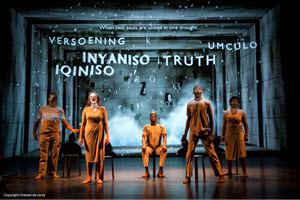
The editorial team chose the image from Umculo's Lamento production for the first issue of the Journal of Black Opera and Music Theatre because it captures several aspects that are important to us.

We, the editorial team, are as multiracial as the protagonists of this production. And we want contributions from people of all races and ethnicities. This also means that language and finding a language for our thematic content is close to our hearts. As the letters in this image find each other to form words, we want to go through this progress of finding words and an academic language together with other scholars. The word "Umculo" (Xhosa and Zulu) in the image means "art music and reconciliation" and our first issue on (de)coloniality also deals with issues of historical and contemporary confrontation with injustice and societal reactions to it. Find the call for paper here.

We will change the image for each issue. Thanks to the Umculo team for allowing us to use this image from Lamento. It is a Pastiche Opera in seven scenes, by Kobie van Rensburg, based on scenic madrigals by Claudio Monteverdi. It was inspired by the Truth and Reconciliation Commission and its reverberation in present-day South Africa and performed 3-6 November 2016 at the Market Theatre, Johannesburg.

Announcements

Current Issue

Vol. 1 No. 1 (2025): Reverberations of Empire? Opera in the Contexts of (De)Colonial and Postcolonial Thought
					View Vol. 1 No. 1 (2025): Reverberations of Empire? Opera in the Contexts of (De)Colonial and Postcolonial Thought

The title of this inaugural issue was directly inspired by the range of submissions we received. Our contributors, whose pieces range from traditional scholarly articles to reflective essays by practitioners, revealed that opera’s colonial entanglements and (de)colonial reverberations cannot be confined to a single conceptual framework. The initial call for submissions foregrounded “de/coloniality“, but the breadth of perspectives led us to adopt the broader title “Reverberations of Empire? Opera in the Context of (De)Colonial and Postcolonial Thought”. This revised title acknowledges the diversity of approaches in the issue and emphasises the productive tensions between critique, practice, and historical legacy that define this field. Accordingly, the issue is conceived as a forum for reflection, collaboration, and critique. It provides a platform for voices that unsettle, reimagine, and recompose what opera and music theatre can mean in the wake of empire, moving between postcolonial reflection and decolonial re-imagining. The project builds on recent critical studies of Eurocentric music theatre and foundational works on Black opera, race, and cultural identity, while pushing those conversations into newer territory.

The contributions in this first issue can be understood as performing postcolonial or decolonial gestures in dialogue with one another often resonating in productive friction rather than in unanimity. Together, they occupy in-between spaces: between what Diana Taylor would call “the archive and the repertoire”, between listening and voicing, between institutionalised structures and fluid formats, between myth and memory.[It is precisely in the contexts of opera and music theatre as spaces of knowledge, representation, and memory that colonial and decolonial narratives are performed, heard, negotiated, and overwritten.

Published: 2025-11-27
View All Issues